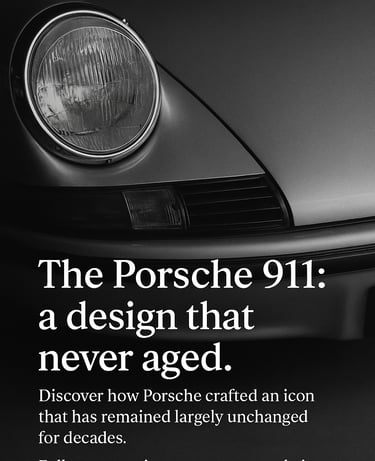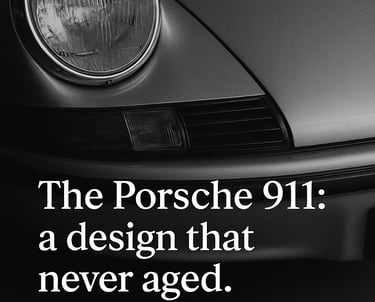
The Porsche 911: A Design That Defied Convention
Originally introduced in 1963, the 911 quickly became a symbol of precision engineering and timeless style. From its debut, Porsche created a car that would remain largely unchanged for decades a true automotive icon.
The Porsche 911:
A Design That Defied Convention
Few cars have remained so faithful to their original idea as the Porsche 911.
From its introduction in the early 1960s, the 911 challenged conventional automotive logic and succeeded because of it.
An unusual beginning
When Porsche introduced the 911 in 1964, its layout raised eyebrows.
A rear-mounted engine was considered unstable and outdated by many engineers at the time. Yet Porsche chose refinement over conformity. Instead of abandoning the concept, the engineers focused on perfecting it.
The result was a car that felt different from anything else on the road.
Engineering over fashion
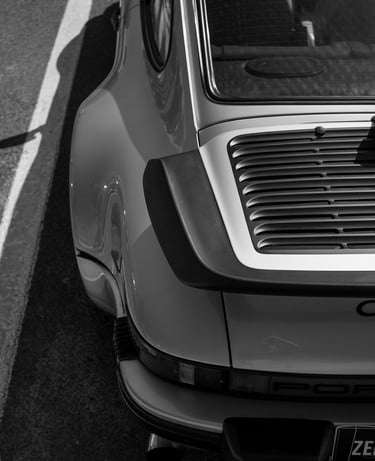
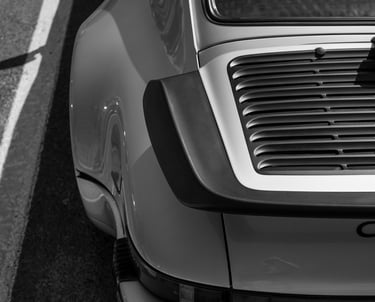
The 911 was never designed to follow trends. Its silhouette evolved slowly, shaped by function rather than fashion. Each generation refined weight distribution, aerodynamics, and mechanical balance without compromising the car’s identity.
This consistency created trust. Drivers knew what a 911 stood for long before they ever sat behind the wheel.
Motorsport as proof
The true validation of the 911 came on the track. Against expectations, the car proved competitive in endurance racing, rally stages, and circuit competitions. Motorsport did not change the 911’s character it confirmed it.
Every race revealed insights that flowed directly back into road cars.
A timeless philosophy
Today, the Porsche 911 is more than a sports car. It is a case study in long-term engineering thinking. By refining a single idea over decades, Porsche created a machine that transcends generations.
The 911’s legacy is not about perfection at launch. It is about commitment to an idea and the patience to improve it endlessly.